
A simple guide to understanding the neurological map of personality changes after brain injury.
Dr. Fareed Rahman
Ayurvedic Doctor, Specialized in Dementia & Neurocognitive Disorders.
(Dr. Fareed Rahman combines modern neurological understanding with Ayurvedic compassionate care to help families navigate life after brain injury.)
The Heartbreak of “The New Person”
In my practice, the hardest conversations I have with families aren’t about physical weakness. The hardest conversations happen when a spouse or child sits across from me, exhausted, and says:
“Doctor, he survived the stroke, but I feel like I’ve lost him. He used to be kind and open-minded. Now, he’s arrogant, he refuses to compromise on anything, and everything is negative.”
If you are living this reality, I want you to hear this first: It is not a choice. It is not a sudden character flaw. It is a symptom of the injury.
When a stroke damages the brain, it doesn’t just affect how a person moves their arm. It can damage the delicate circuits that control their personality, their “social filter,” and their ability to feel hope.
To have patience, we first need understanding. Let’s look at the “geography” of these behaviors in a simple way.
The Brain: A Company with Different Departments
Think of the brain like a large company. For the company to run smoothly, every department needs to do its job and communicate with the others.
▪️The CEO (Frontal Lobe): Makes big decisions, plans ahead, and manages public relations (keeping you polite).
The Context Team (Right Hemisphere): Reads the room, understands tone of voice, and sees the “big picture.”
The Engine Room (Deep Structures): Manages automatic habits and regulates emotional fuel (positivity vs. negativity).
When a stroke hits, it’s like a power outage in one of these specific departments.
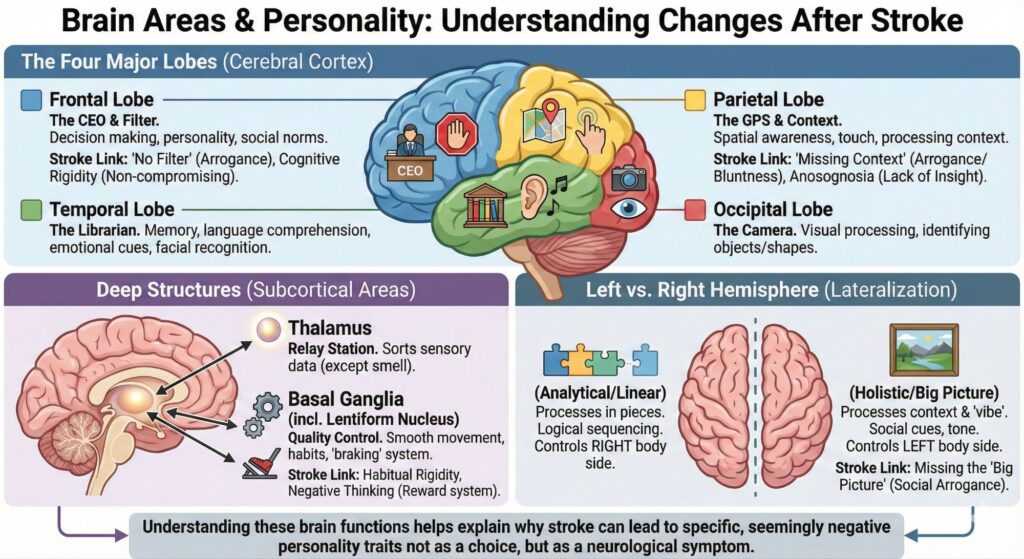
Here is a visual map of how damage to specific areas leads to the behaviors that are frustrating you.
Why Are They Acting Like This? Breaking Down the Behaviors
Let’s connect the behaviors you are seeing at home with the brain areas shown in the image above.
1. The Behavior: Sudden Arrogance and “No Filter”
Where is the damage? The Frontal Lobe (The CEO)
We all have rude or selfish thoughts sometimes. A healthy frontal lobe acts as your brain’s braking system. It says, “Don’t say that out loud, it’s hurtful.”
If a stroke damages this braking system, the person loses their “social filter.” They might boast, insult others, or act superior because the part of the brain responsible for modesty and social awareness is literally offline. They aren’t trying to be arrogant; they just lost the ability to stop themselves.
2. The Behavior: Stubbornness and Refusing to Compromise
Where is the damage? The Frontal Lobe (again)
Besides being a filter, the frontal lobe helps us shift mental gears. It allows us to see another person’s perspective during an argument.
When damaged, the brain develops “cognitive rigidity.” It gets stuck on one track like a broken record. They cannot compromise because their brain physically cannot shift to a new idea. It feels like stubbornness to you, but to them, it’s the only reality their brain can process.
3. The Behavior: Missing the Point and Acting Cold
Where is the damage? The Right Hemisphere (The Context Team)
The right side of the brain helps us understand the “vibe” of a situation—sarcasm, humor, and emotional tone.
If the stroke hits the right side, the person might only understand the literal words you say, missing the emotion behind them. They might respond with cold facts when you need empathy. They seem arrogant or uncaring because they are “missing the big picture” of the social interaction.
The Insight Problem (Anosognosia): Sometimes, damage here causes a person to be completely unaware of their own disability. They might try to stand up even though they are paralyzed. When you tell them they can’t, they get angry and dismissive. They aren’t in denial; their brain can’t understand their situation.
4. The Behavior: Constant Negativity
Where is the damage? Deep Structures (The Engine Room)
Deep inside the brain are areas (like the Basal Ganglia) that help regulate our habits and our sense of reward.
When your loved one is being rigid or arrogant, the natural instinct is to argue with logic. But because their brain has changed, logic rarely works. Arguing with a damaged frontal lobe will only frustrate both of you.
“The take-home message is this: Their brain has changed, so your approach must change too. Patience, simplifying communication, and seeking professional guidance on behavioral management are key to navigating this new reality.”
Your Dementia Specialist
Dr Fareed Rahman (BAMS, MSc(Psy), PGD in Mental Health )